
Agree on what sharing is for, enable only the information the owner chooses and keep pause/revocation available. A partner's read-only view is a support tool, not access to the whole journal.
Period tracker partner sharing can make a small practical preference easier to communicate. It should not turn a relationship into a dashboard someone is expected to keep updated for another person's reassurance.
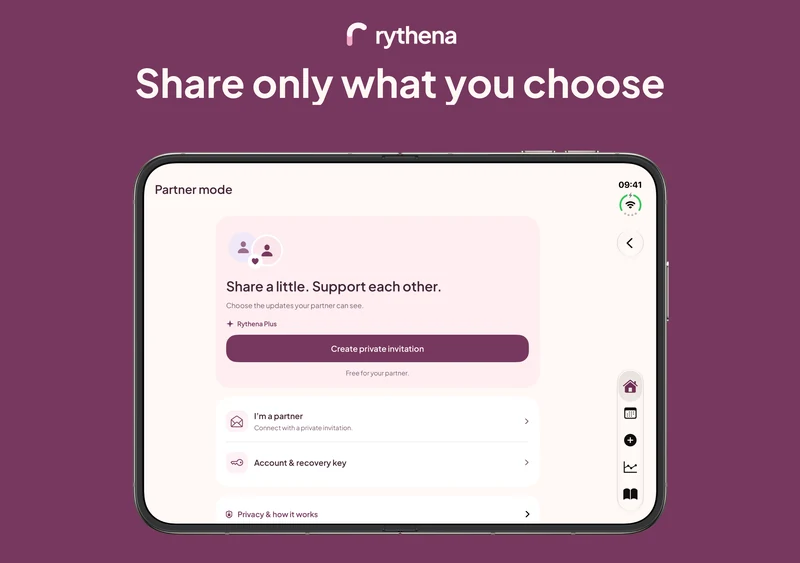
Before connecting the upcoming Rythena Partner mode, spend a moment agreeing on what you want the feature to do. The conversation matters as much as the invitation flow.
Start with the purpose
Ask a direct question: “What information would actually help us?” Perhaps a period heads-up is useful for planning. Perhaps a saved preference such as wanting company or practical help would be enough. You may decide no cycle information is needed.
The owner can change their mind. Consent to share today should not become a permanent expectation that every future mood, estimate or private note must be visible.
Treat each permission as its own choice
Rythena separates cycle information, fertility estimates and today's saved mood. Those permissions begin disabled. Turning on one should not turn on the others or expose notes, custom wording, intimacy or test records implicitly.
Read the preview and labels before approving. “Estimated” and “recorded” mean different things. A partner should not interpret an estimated date as a confirmed event or use it to contradict the person whose journal it is.
Verify the connection together
Use the private single-use invitation and compare the matching verification codes. If they do not match, stop rather than approving for convenience. The owner explicitly approves before health data becomes visible.
The recipient receives a read-only partner experience without cycle-journal onboarding or a separate Plus subscription. They do not receive the owner's account credentials, journal-editing access or recovery key. Owner creation/publication requires Plus; reducing sharing or revoking access remains free.
Prefer a stated preference to a phase assumption
“I would like someone to listen” is a direct shared preference. “Your phase says you must be emotional” is an inference the app should not encourage.
Use the dashboard as a starting point for asking, not as an authority over another person's feelings. Check the last-updated time. An older preference may no longer fit, and a missing update is not evidence that something is wrong.
Make notifications optional
Discuss whether notifications are welcome and which quiet hours make sense. Neutral Lock Screen text reduces casual disclosure, but both people should still understand that iOS can delay or skip background delivery.
Do not use the feature for urgent communication or assume someone received an update immediately. A notification setting is not a delivery contract or a relationship obligation.
Know how to stop
Pause stops local publication. A disconnect or permission reduction may show pending server revocation when offline. Keep that distinction visible rather than assuming every remote copy is gone at once.
Information already seen or copied cannot be recalled. For the actual flow, see the period tracker for couples guide. For wider controls, read the private tracker guide.
Sources & product basis
Product steps checked against Rythena’s upcoming iOS implementation and listing. Examples are illustrative. AI-assisted writing; no clinical sign-off. Sources checked 2 November 2026. Editorial approach and corrections.
Make it a smaller routine.
See the app, check what stays free and choose the tools that help you.
Explore upcoming Rythena