The short answer
A comparison can show how saved observations line up across recorded cycles. It cannot establish a cause, explain missing days or diagnose a condition from repetition alone.
Looking for cycle symptom patterns can help you ask a more specific question. It becomes less useful when a chart is treated as proof of a cause or a prediction of your personality.
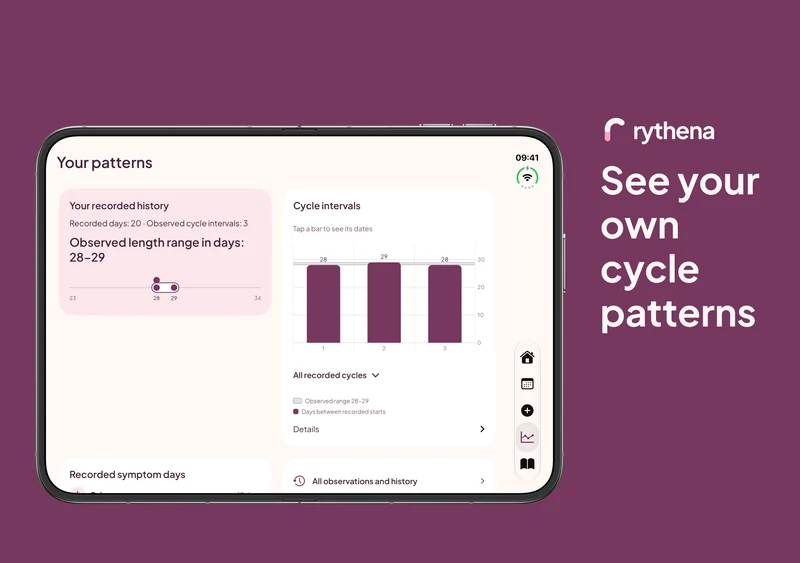
Rythena Plus adds descriptive comparisons to the upcoming app. The free journal and full history remain available, so you can decide whether these extra views answer a question you actually have.
Start with a question you can check
“Did I record headaches around a similar point in recent cycles?” is a question your saved dates may help explore. “Does my cycle cause every headache?” asks for a conclusion a journal comparison cannot provide.
Keep the question small enough to inspect the underlying entries. If a chart highlights a date, open the record and read what you actually saved. Do not rely only on the visual shape of a trend.
Missing is not the same as absent
Imagine two synthetic cycles. In the first, you logged daily; in the second, you opened the app only on difficult days. The number of symptom entries may differ even if your experience was similar.
A blank date can mean you did not record anything. It should not automatically become a symptom-free day, a low-intensity mood or a period end. The completeness of the record changes how confidently you can interpret a comparison.
Timing can also change the picture
A symptom saved one day late can appear at a different cycle position. A corrected period start can shift the alignment of an entire cycle's observations. This is a reason to check dates, not to smooth away genuine differences.
When you edit a source record, revisit the comparison. The new view should describe the corrected journal, while your selected prediction mode remains a separate choice. A chart update is not necessarily a new biological insight.
Keep the rest of life in the conversation
Work, sleep, travel, illness and personal circumstances can matter to how you understand a day. A calendar cannot determine how much each factor contributed simply because two observations appeared together.
You can note relevant context in your own words, then decide what you want to discuss. Notes remain separate from the limited mood or cycle summary you might choose to share with a partner.
Choose Plus for a useful job
If comparing cycles helps you review your record, Plus may offer a convenient view. If you mainly need period dates, a day counter and occasional notes, the free journal may already do the job.
Neither option validates a diagnosis. A paid view does not turn a correlation into a cause, and a free PDF can still be useful for an appointment. Review the actual feature and current store price before deciding to subscribe.
Continue with the free-versus-Plus checklist, a symptom tracker routine or a report for an appointment.
Sources & product basis
Product steps checked against Rythena’s upcoming iOS implementation and listing. Examples are illustrative. AI-assisted writing; no clinical sign-off. Sources checked 2 November 2026. Editorial approach and corrections.
Make it a smaller routine.
See the app, check what stays free and choose the tools that help you.