
Choose the symptoms you want to remember, save them on the right date and add detail only when it helps. A symptom tracker records experiences; it cannot diagnose their cause.
A period symptom tracker should help you remember your experience, not ask you to prove it through a long form. You might want to track one recurring headache, a day of bloating or whether cramps interrupted work. That is enough to begin.
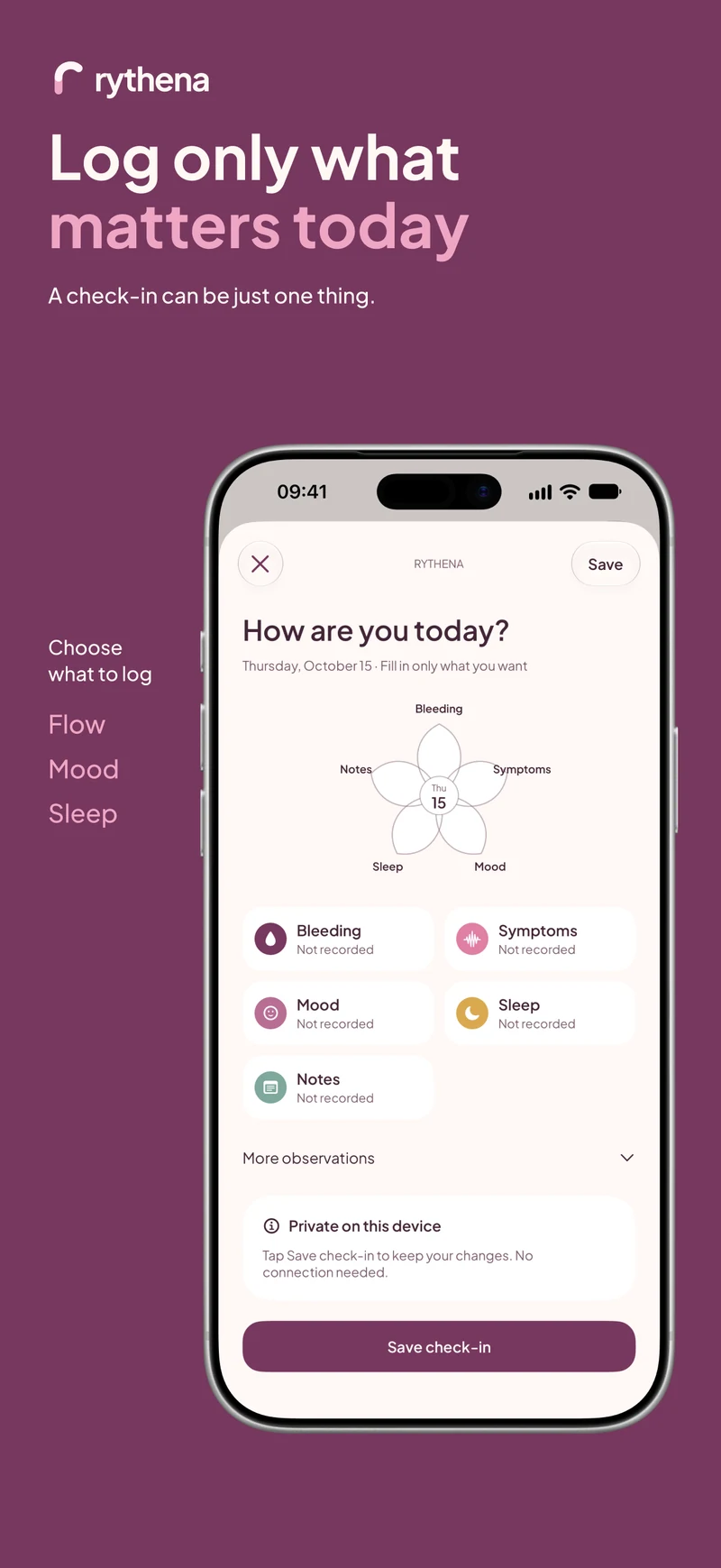
Rythena's upcoming symptom flow lets you choose an observation first. Intensity and other details are optional. You can use favorites for familiar choices and search the broader list when something different matters.
Pick a question before picking every symptom
Start with a practical question: “Which days did cramps interfere with my plans?” is easier to track consistently than “I must record every body sensation.” Choose the few observations that will help you answer it.
If two labels seem close, read them carefully and use the one that best describes what you experienced. You can use custom wording when the standard list does not fit. A useful journal does not require replacing your description with a more medical-sounding word.
Save the date and the observation
Open Log today, then the symptom section. Check the selected day before choosing a symptom, particularly if you are adding an earlier experience. Select what applies, add any useful detail and save the check-in.
For a symptom that is already selected, use the available detail/edit controls instead of adding another label merely to express greater intensity. Remove an accidental selection before saving. After closing the editor, check that the record appears on the intended day.
Record impact in plain language
Compare these two illustrative notes: “Cramps” and “Cramps interrupted the walk home.” The second adds functional context without making a diagnosis. You do not need a paragraph: “missed lunch,” “woke me up” or “needed a break” may capture what you want to remember.
Keep personal notes separate from any information you choose to share. In Partner mode, enabling a cycle or saved-mood scope does not automatically grant access to symptom notes or custom wording.
Look for repetition without assuming a cause
Over time, you can inspect recorded days in history. Plus adds descriptive comparison tools, but seeing two things together does not establish that one caused the other. Days without observations are also not proof that a symptom was absent.
For premenstrual symptoms, the NHS suggests keeping a symptom diary across at least two cycles to discuss with a GP. Do not wait to finish a tracking exercise if symptoms are affecting daily life or you need care sooner.
Bring a manageable record to an appointment
The free standard report provides a way to review records before choosing to share them. Select a useful date span, create the PDF and inspect it. Check dates and included details, then share only if you want to.
A report is a conversation aid, not a diagnosis. Add your own question, such as “Could we discuss this change?” You can read more about preparing a symptom diary for an appointment or follow the period tracking PDF guide.
Sources & product basis
Product steps checked against Rythena’s upcoming iOS implementation and listing. Examples are illustrative. AI-assisted writing; no clinical sign-off. Sources checked 2 November 2026. Editorial approach and corrections.
Make it a smaller routine.
See the app, check what stays free and choose the tools that help you.
Explore upcoming Rythena