
Save the mood that fits your experience on the correct day. Use specific words when broad labels do not fit, and interpret repeated observations as descriptions rather than proof of a hormonal cause.
A period mood tracker can be useful even when you are not trying to connect every feeling to your cycle. Its simplest job is to help you remember how a day felt in words that make sense to you.
The upcoming Rythena mood picker uses illustrated choices and a broader vocabulary than a handful of happy-or-sad labels. Familiar choices move toward the front as you use them, so routine check-ins do not require repeatedly searching a long list.
Choose specificity without turning it into a test
“Restless,” “tense,” “excited” and “impatient” can describe quite different experiences. Choose the closest fit rather than the word you think you are supposed to feel at that point in a cycle.
The illustration helps you find a label, but the written label still matters. If the expression does not match your interpretation, use the wording as your reference. You can change a mistaken selection before saving.
Save a small observation
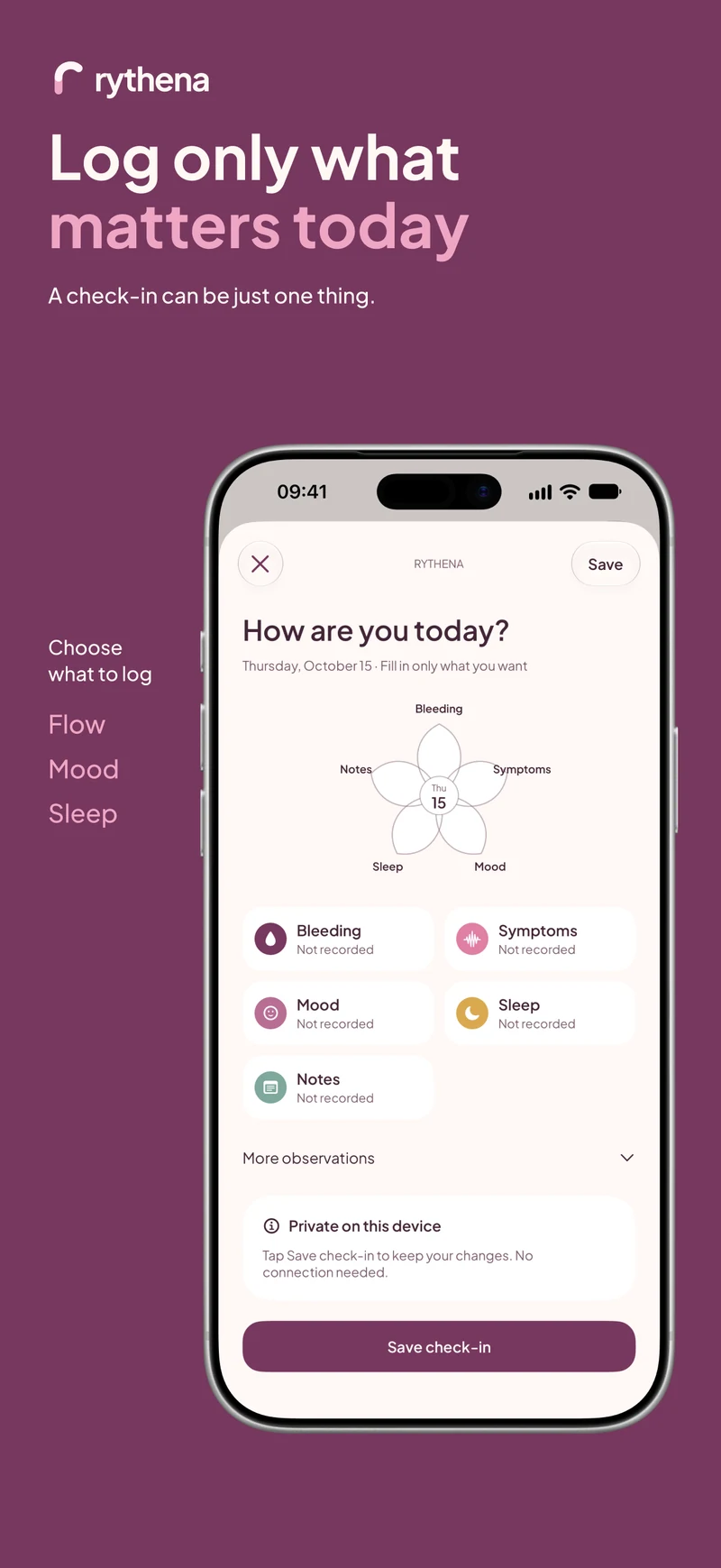
Open Log today, then Mood. Check the day, select the choice that fits and use Done to return to the check-in before saving it. Leaving the mood picker and saving the journal entry are separate steps.
If you opened the picker only to explore, do not assume that an unsaved draft has become today's recorded mood. This distinction matters particularly if you enable sharing of today's saved mood with a partner.
Let frequent choices make the list faster
Frequent ordering is a shortcut, not a prediction about your personality. A mood near the front appears because of your use, not because the app has determined what you will feel today.
If your usual word does not fit today, take the extra moment to choose another. Do not accept the first item merely to finish the screen. If you want a lighter routine, a single honest check-in on a day that matters is still a meaningful record.
Keep your private context private
You may want to add personal context, such as a difficult meeting or a pleasant conversation. Treat notes as their own record. The partner saved-mood permission should not expose notes, custom wording, intimacy or test records implicitly.
Sharing can be supportive when it is freely chosen. It should not become a way for another person to monitor whether your feelings match an expected phase. Use pause or permission controls whenever the arrangement stops being helpful.
Review patterns with some humility
A calendar can show that observations were saved around similar cycle days. It does not explain everything else that happened on those dates. Sleep, circumstances, relationships and missing records may all change the story you tell about a pattern.
Use comparisons to start a question rather than finish an argument. “I noticed I recorded this more often here” is more accurate than “My cycle makes me behave this way.” For more examples, read mood patterns without assumptions and choosing a more specific mood word.
Sources & product basis
Product steps checked against Rythena’s upcoming iOS implementation and listing. Examples are illustrative. AI-assisted writing; no clinical sign-off. Sources checked 2 November 2026. Editorial approach and corrections.
Make it a smaller routine.
See the app, check what stays free and choose the tools that help you.
Explore upcoming Rythena