The short answer
The fertile window covers days around the opportunity for conception. Ovulation is an event. An app's estimated reference day is a visual aid within uncertainty, not proof that the event occurred.
The distinction between fertile window vs ovulation day explains why a calendar can shade several dates but should not suggest you have several confirmed ovulation events. One treatment describes a window; another provides an estimated reference within it.
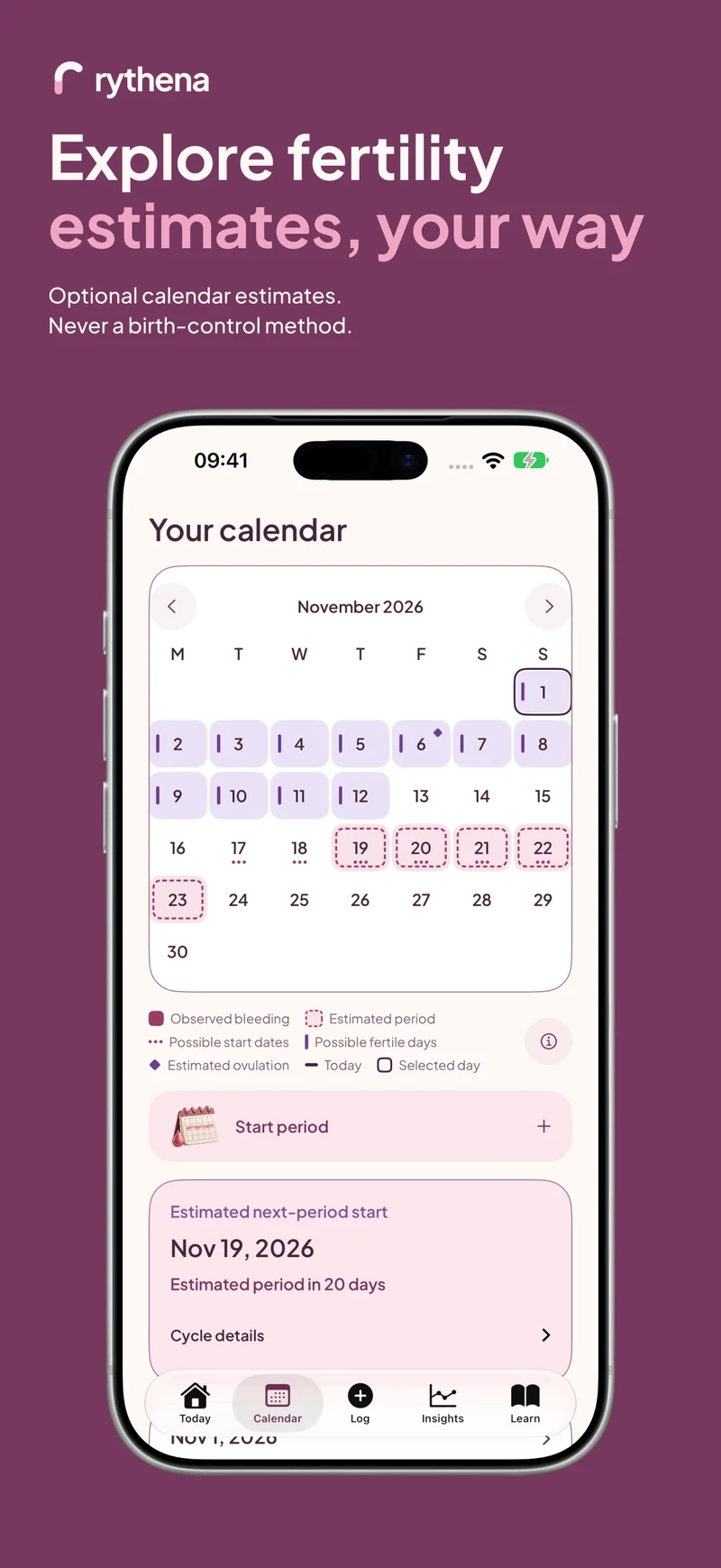
Rythena's upcoming optional fertility layer uses separate visual treatments so the meaning does not depend on reading a long paragraph every time you open Calendar.
A window is not a list of confirmed events
The ASRM defines the fertile window as the six-day interval ending on ovulation. A calendar prediction also has uncertainty about which day ovulation might occur, so the app's displayed possible range may be wider than that biological definition.
That wider display is not a claim that every marked day is equally likely, and it is not confirmation that ovulation occurred on any of them. A forecast and a measurement answer different questions.
What the single reference marker means
Rythena uses one distinct estimated ovulation reference inside the possible-date range when its rules permit. Its role is to help you find the reference quickly, without making several similar dates look like several “ovulation days.”
The word Estimated still applies. Choosing one visual reference does not erase uncertainty or turn a calendar midpoint into a test result. If you need to inspect the basis, open the information detail rather than judging from the marker's confidence-looking shape.
Read the legend alongside the saved state
Start by finding recorded period information. Then distinguish the predicted bleeding span, possible fertile days and the estimated ovulation marker. Today and the selected date add another layer; they should not hide the underlying state.
For an illustrative future month, a selected day might fall inside a possible fertile window without being the reference day. Tapping it selects the date; it does not confirm that date's fertility status. Colour and selection are different kinds of information.
Why the layer might disappear
An ongoing tracked period, recorded menstruation, an unsupported context, a passed estimate or variable/insufficient inputs can make the fertility layer unavailable. The correct response is an explanation, not a new marker invented to keep the calendar busy.
Early eligible setup/manual information can support a provisional layer. That still differs from a history-based estimate and does not automatically enable fertility reminders. Keeping fertility off remains a valid choice for period tracking.
Do not turn the marker into a safe-day rule
Rythena is not contraception, and its calendar cannot confirm ovulation or identify days when pregnancy is impossible. A period forecast should not be used to decide that unprotected sex is safe.
Use the app to organize observations and questions, and seek appropriate professional advice about conception or contraception. For the settings and eligibility explanation, follow the ovulation-calendar guide. For a different calendar layer, read cycle length vs period length.
Sources & product basis
Product steps checked against Rythena’s upcoming iOS implementation and listing. Examples are illustrative. AI-assisted writing; no clinical sign-off. Sources checked 2 November 2026. Editorial approach and corrections.
Make it a smaller routine.
See the app, check what stays free and choose the tools that help you.