
An ovulation calendar gives a planning estimate, not proof that an egg was released. Rythena separates the fertile-day window from one estimated ovulation reference and shows the layer only when you opt in and its safety rules permit it.
Ovulation calendar estimates can help explain the app's calendar, but they cannot establish what happened inside your body. A future-looking calculation and a confirmed biological event are different kinds of information.
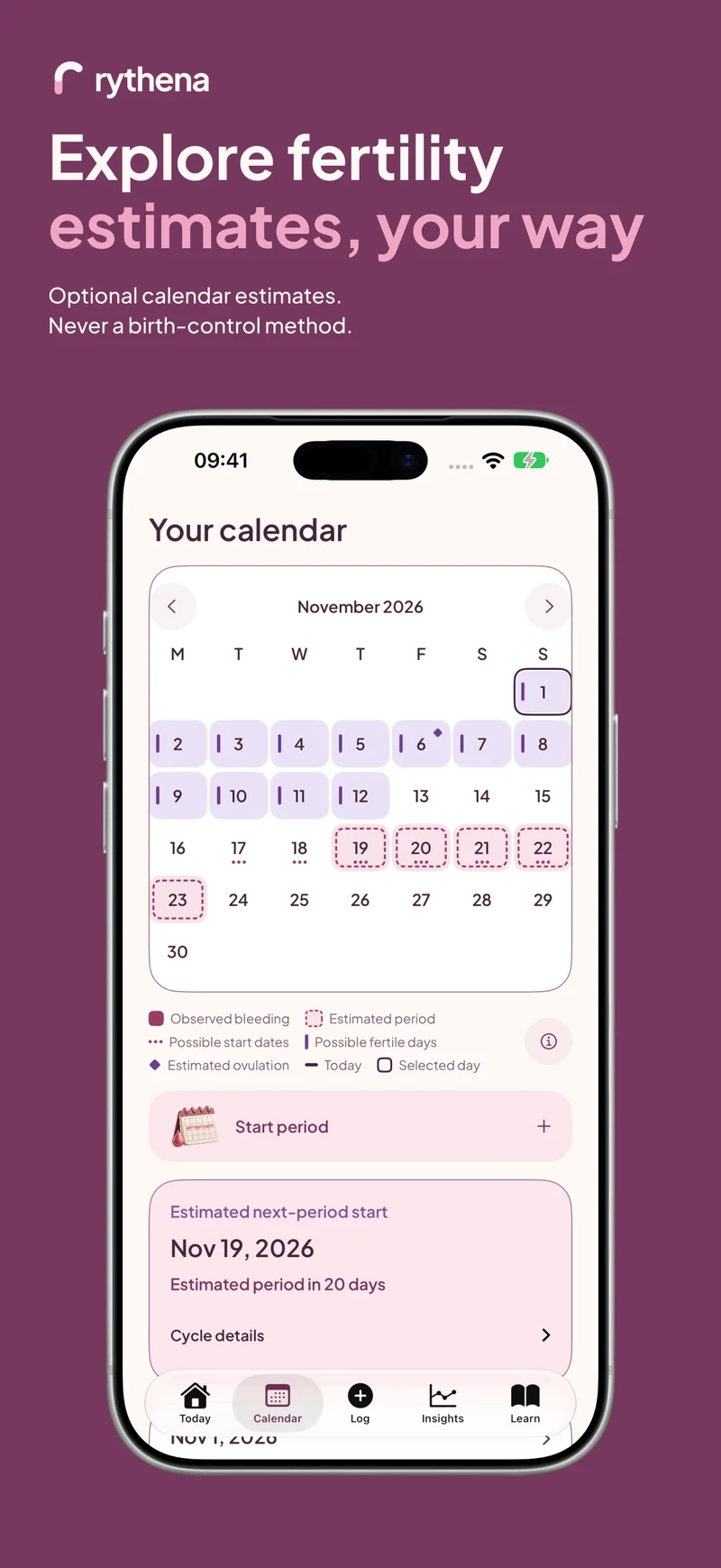
Rythena's upcoming fertility layer is optional. You can use its period journal without it. When enabled and eligible, it separates a possible fertile-day window from a single estimated ovulation reference within that uncertainty.
Why a window covers several days
The fertile window and ovulation are not synonyms. The ASRM describes the fertile window as the six-day interval ending on ovulation. A calendar app must additionally account for uncertainty about when ovulation might occur.
That means several shaded dates should not be labelled as several confirmed ovulations. Rythena uses a distinct estimated reference marker inside its possible-date range. Even that one marker is a visual reference, not a test result or a guarantee.
Turn the layer on only if it is useful
Use Show fertility estimates in the app's calendar controls. Then inspect the compact legend and information detail. Look for the word Estimated, the distinct ovulation marker and the broader possible fertile-day treatment.
If you are mainly tracking bleeding and symptoms, leave fertility off. The app should not require you to interpret fertility information to complete a daily check-in. Turning the estimate layer off does not delete saved observations.
Understand why an estimate may be unavailable
Rythena can withhold the layer during an ongoing tracked period or recorded menstruation, when the current context does not support the calculation, when its period forecast is unavailable or overdue, or when history is too variable for the product's eligibility rules.
With limited history, an eligible manual/setup estimate may be provisional. A provisional visual estimate does not qualify automatically for fertility reminders. When the app explains why the layer is unavailable, do not enter invented dates merely to make a marker appear.
Keep settings and observations distinct
A manually entered usual length tells the app which calendar assumption to use. It does not confirm a hormone pattern. A saved symptom, temperature or test observation is also not permission for the calendar to claim clinical certainty it has not established.
You can inspect the selected cycle calculation through Cycle details and Edit cycle calculation. The app should not silently replace your choice with another mode because that produces a more attractive date.
Do not use this calendar as contraception
Rythena's calendar estimates are not a birth-control method. Fertility-awareness contraception involves specific instruction and observations; it should not be confused with looking at a predicted app window. The NHS advises learning suitable fertility-awareness methods from a trained professional.
For contraception or questions about conception, seek advice suited to your situation. The app can organize observations for that discussion, but it cannot guarantee a fertile date, confirm ovulation or identify safe days for unprotected sex.
See fertile window versus ovulation marker for a visual-reading example, and why fertility is paused during a tracked period for the bleeding-state distinction.
Sources & product basis
Product steps checked against Rythena’s upcoming iOS implementation and listing. Examples are illustrative. AI-assisted writing; no clinical sign-off. Sources checked 2 November 2026. Editorial approach and corrections.
Make it a smaller routine.
See the app, check what stays free and choose the tools that help you.
Explore upcoming Rythena