
When cycles vary, prioritize an accurate record over a precise-looking forecast. Rythena keeps logging and history useful even when its calculation rules withhold period or fertility estimates.
An irregular period tracker should not make you change real dates until they resemble a tidy calendar. Its most valuable job may be helping you show what actually happened, including differences between cycles and gaps you cannot confidently fill.
Rythena's upcoming journal keeps observations separate from estimates. An unavailable forecast does not mean that your saved history has stopped being useful, and it is not a diagnosis.
Begin with a reliable timeline
Record period starts you know. For explicitly tracked periods, add the end when you know it. If you are uncertain about an older date, preserve that uncertainty instead of selecting an arbitrary day to finish setup.
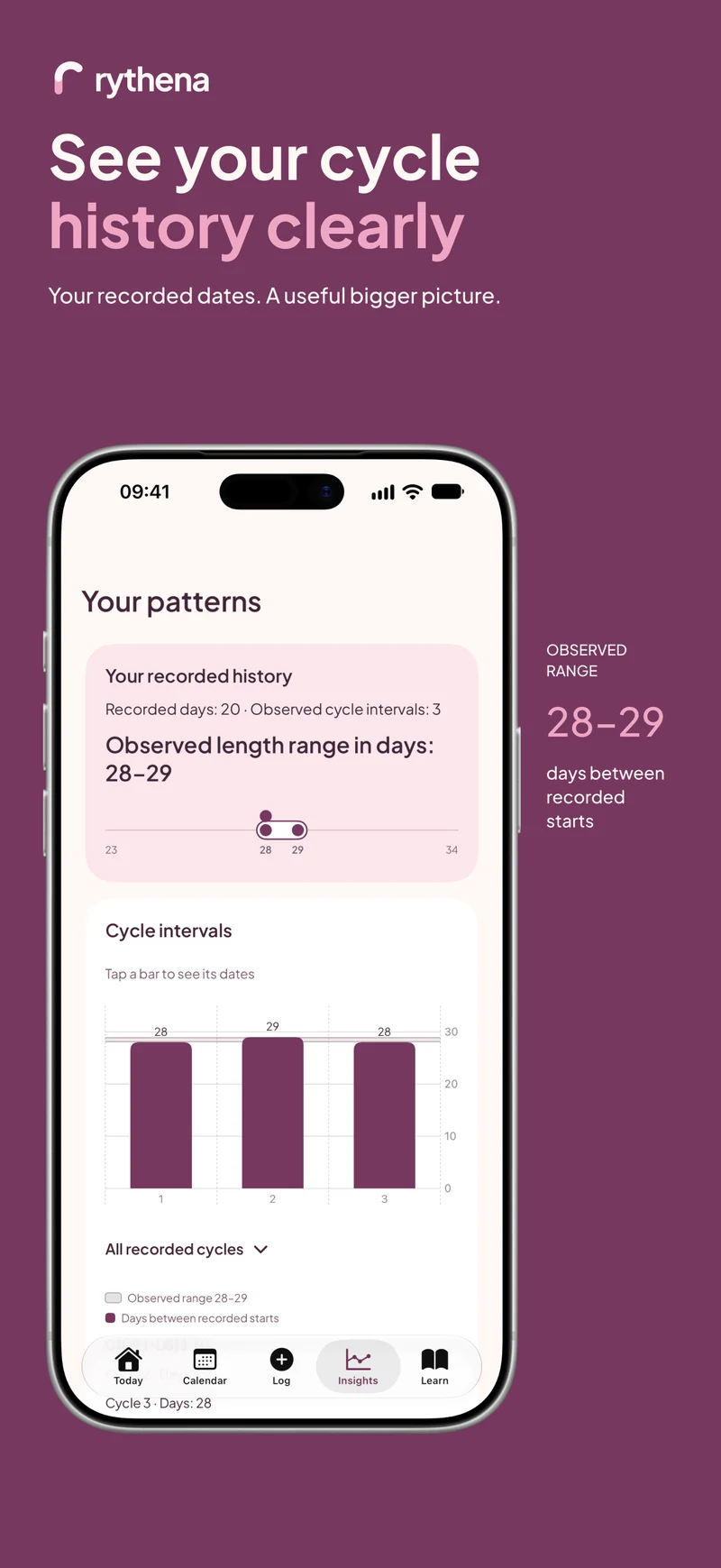
Keep start-to-start cycle length separate from bleeding duration. A long interval between periods and a long episode of bleeding are different observations. Both may matter in a conversation with a healthcare professional, but averaging them together would obscure rather than clarify your record.
Expect some forecasts to be withheld
The app checks context, available history and variability before presenting certain estimates. A manual usual length does not override all of these rules. If its calculation cannot support a forecast, Rythena should give an explanation rather than a persuasive countdown.
Fertility estimates have additional eligibility requirements. Keeping those markers absent can be the correct behavior. It does not mean that the app has concluded you are infertile, not ovulating or unable to become pregnant.
Check corrections without tidying away variation
An accidentally duplicated start or incorrect date deserves a correction. A genuinely different interval deserves preservation. Before editing, ask whether you are fixing a recording error or trying to make the picture match an expected pattern.
If you discover that an ongoing period ended earlier, edit its actual last day. Do not leave it open to influence an average, and do not close it automatically just because a usual duration has elapsed. An expected duration is not evidence of an actual end.
Add context selectively
You may find it useful to record a symptom or a question you want to discuss. A few consistent observations can be easier to review than many categories filled sporadically. Missing daily entries should stay missing; they are not the same as symptom-free days.
If you use a changing life/tracking context, read how that context affects estimates. Do not select a natural-cycle setting simply to obtain an ovulation marker when that setting does not describe your situation.
Bring the pattern to a professional
The NHS recommends speaking to a GP if periods are irregular or the normal pattern changes. You do not need to establish a cause or collect months of perfect data before asking for help.
In Rythena, use full history and the free standard PDF to review the date span you want to bring. Add your own main question. A report can make it easier to discuss a pattern, while a healthcare professional decides what assessment is appropriate.
Related reading: how to calculate cycle length, tracking when periods vary and preparing a PDF report.
Sources & product basis
Product steps checked against Rythena’s upcoming iOS implementation and listing. Examples are illustrative. AI-assisted writing; no clinical sign-off. Sources checked 2 November 2026. Editorial approach and corrections.
Make it a smaller routine.
See the app, check what stays free and choose the tools that help you.
Explore upcoming Rythena