
Cycle length is the number of days between one period start and the next. It is different from the number of days you bleed. Rythena lets you choose a manual usual length or an eligible history-based average.
If you are looking for how to calculate cycle length, use the start of one period and the start of the next. Count the interval between those dates. Do not use the last day of bleeding as the end of your cycle calculation.
The first day of a period is cycle day 1. The next period begins a new cycle. A person can therefore have a six-day period inside a 28-day cycle; those numbers describe different things.
Work through a start-to-start example
Imagine a period starts on 1 March and the next begins on 29 March. There are 28 days between those starts. The completed cycle runs from 1 through 28 March; 29 March is the next cycle's first day.
Now imagine the following start is 28 April. That next interval is 30 days. Writing down both intervals preserves a detail that a single “monthly” label would hide.
| Period start | Next start | Completed interval |
|---|---|---|
| 1 March | 29 March | 28 days |
| 29 March | 28 April | 30 days |
| 28 April | 27 May | 29 days |
The arithmetic average of these three intervals is 29 days. This example explains the calculation; it is not a prediction for any particular reader.
Choose what drives Rythena's prediction
In the upcoming app, open Cycle details, then Edit cycle calculation. You can select a manual usual cycle length or the history-based option. Save the choice you intend to use.
Manual mode is useful when you know your usual length and want that value to remain explicit. Entering 28 is a personal setting, not a statement that everyone's cycle should be 28 days.
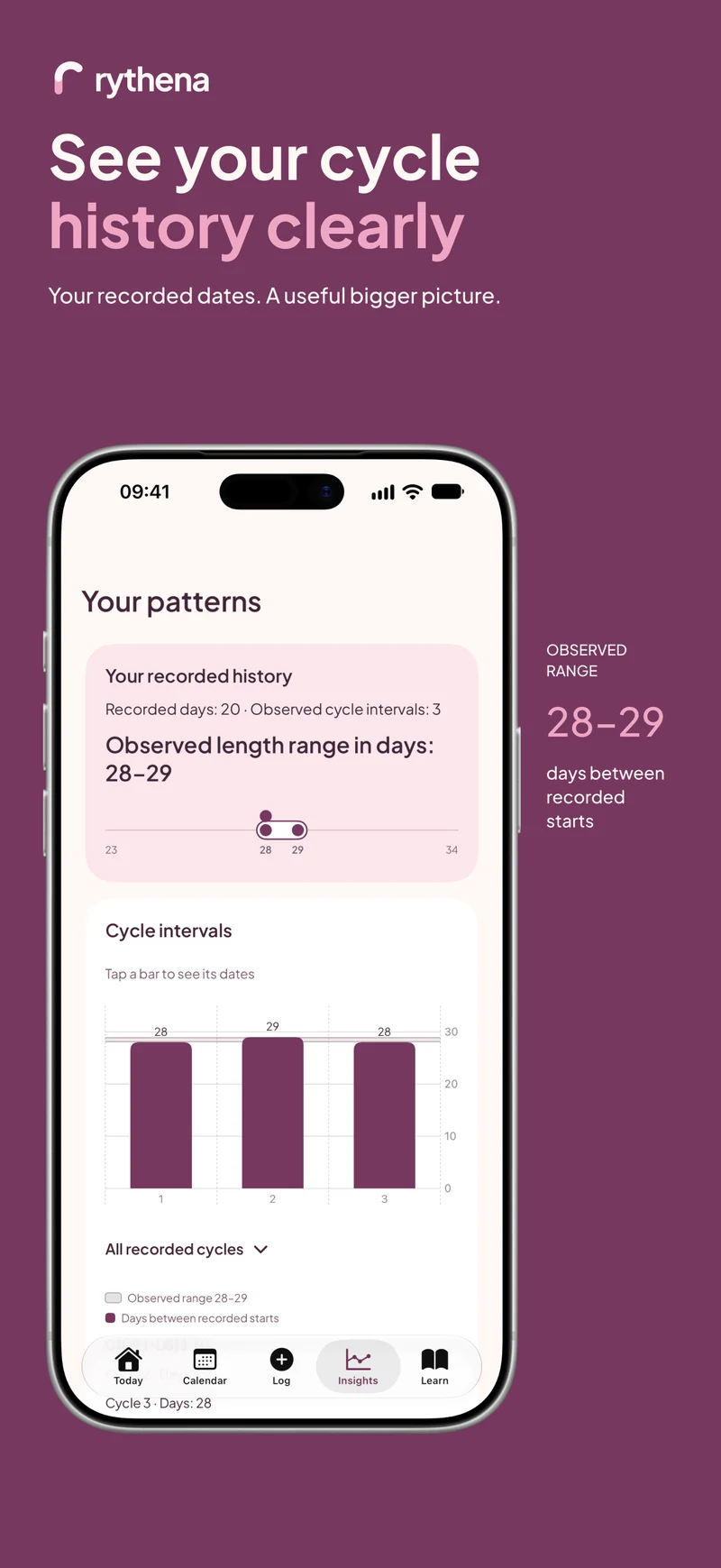
History mode needs at least three eligible recorded start-to-start intervals. It uses up to the six most recent eligible intervals and rounds their average to a whole day. Context and variability rules can still withhold a forecast. The app should explain an unavailable estimate instead of silently switching your selected mode.
Keep bleeding duration separate
Your usual bleeding duration shapes a predicted bleeding span; it does not replace cycle length. Rythena estimates duration from eligible explicitly ended period episodes when there is enough history. It otherwise uses the configured duration or its labelled product fallback.
For example, a 29-day interval and an approximately six-day bleeding span can both be appropriate descriptions of one synthetic history. Changing bleeding duration to six should not turn a 29-day cycle into a six-day cycle.
Check the input before changing the setting
If the result looks wrong, inspect the saved start dates first. Was a start accidentally entered twice? Was an older period added on the wrong date? Did you select a setup answer that you meant to leave unknown?
Correct actual errors, but do not edit a truthful unusual interval just to make the average look tidy. A changing pattern may be important context. Speak with a healthcare professional if your periods become irregular or your usual pattern changes; an app cannot establish the cause.
Continue with manual settings versus recorded averages or tracking irregular periods if one average is not describing your experience well.
Sources & product basis
Product steps checked against Rythena’s upcoming iOS implementation and listing. Examples are illustrative. AI-assisted writing; no clinical sign-off. Sources checked 2 November 2026. Editorial approach and corrections.
Make it a smaller routine.
See the app, check what stays free and choose the tools that help you.
Explore upcoming Rythena