The short answer
Start one ongoing period episode and record its real end when you know it. The day counter advances from that start; it does not require a new period-start record every day or invent daily flow observations.
A period day counter should make a busy morning easier. If you saved that your period started three days ago, opening the app today should not make it look as though you only had one isolated day of bleeding.
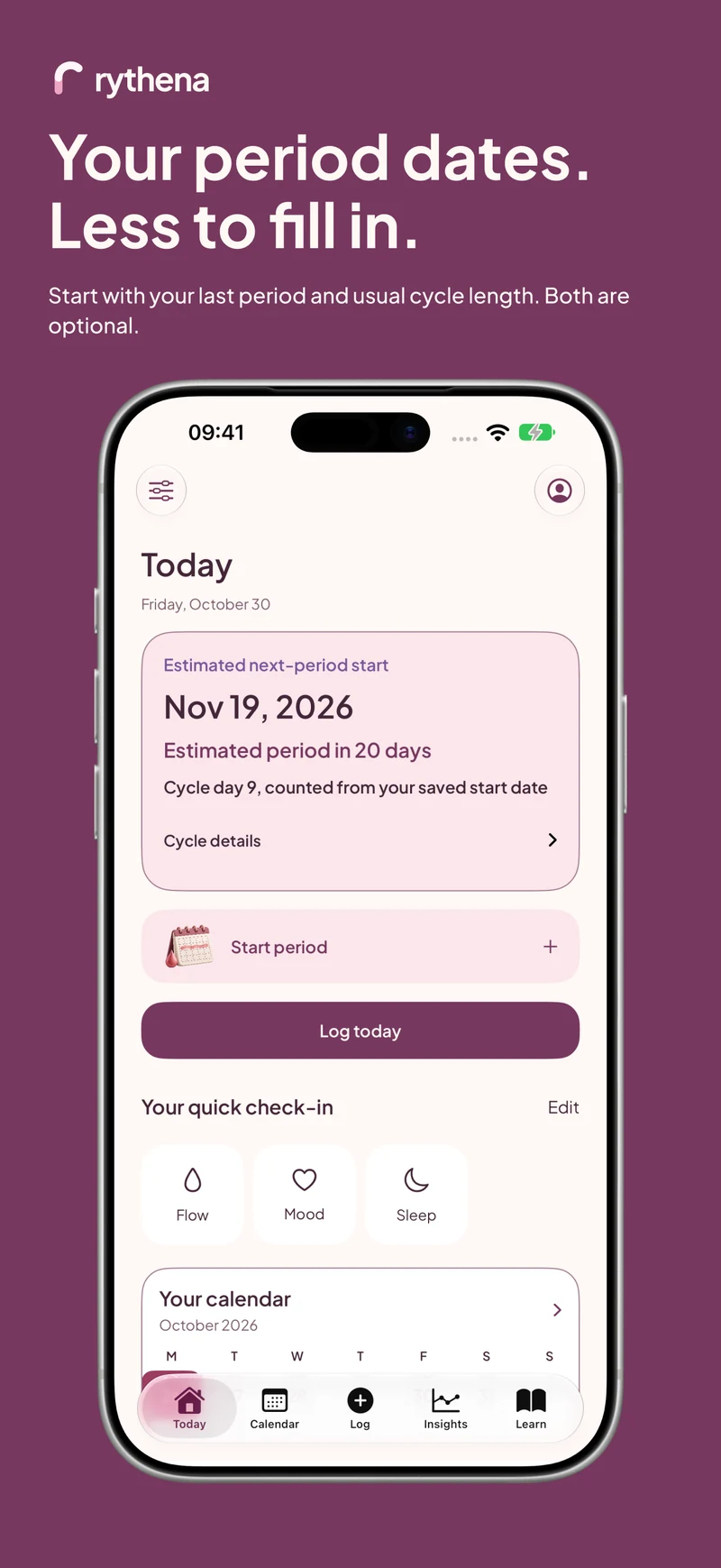
The upcoming Rythena app treats an ongoing period as an episode. You start it once, check its current day and explicitly record the end. That gives the counter a clear meaning without asking you to log the same start repeatedly.
What “day 4” means
Imagine you save a period start on Monday. Monday is day 1, Tuesday is day 2, Wednesday is day 3 and Thursday is day 4. The counter describes elapsed calendar days since that saved start, including the first day.
It does not say the app observed your body on Tuesday or that you entered a particular flow intensity on Wednesday. Episode tracking and individual observations remain different layers of the journal.
Leave the episode open while it is ongoing
Use Start period on Today and verify the start date before saving. If you do not open the app tomorrow, the episode stays ongoing. You do not need to add another start to make the counter move.
Daily observations remain optional. If you want to record flow changes or a symptom on a particular day, add that observation on its own date. If you do not, the app should preserve a gap rather than fill it with made-up details.
End it with the last day you actually mean
When the period finishes, choose End period and check the last-day selection. If you are recording the end a day later, make sure you have not accidentally chosen the day you opened the screen instead of the last bleeding day.
For an older completed episode, check both boundaries. The end should not precede its start or overlap another episode because of an accidental selection. Correct the record rather than adding a second episode to work around a mistaken date.
Why usual duration does not close the episode
An estimated usual duration is useful for drawing a future predicted bleeding span. It is not evidence that an ongoing period has ended. Automatically closing every episode at that duration would replace your experience with the app's expectation.
If an episode is still open long after you intended, review it. Perhaps you forgot to record an end, or perhaps the record is accurate and you want to discuss the experience. The app cannot decide between those possibilities for you.
Keep the screen's answer short
The immediate question is often simply, “Which day am I on?” A clear counter and an obvious End action answer it more directly than a paragraph about cycle phases. Detailed calculation explanations can stay a tap away.
For the future-looking count, see the period countdown guide. For the difference between an episode and a cycle interval, read cycle length vs period length.
Sources & product basis
Product steps checked against Rythena’s upcoming iOS implementation and listing. Examples are illustrative. AI-assisted writing; no clinical sign-off. Sources checked 2 November 2026. Editorial approach and corrections.
Make it a smaller routine.
See the app, check what stays free and choose the tools that help you.