The short answer
An eligible last-period setup date and usual cycle length can support an early, clearly labelled estimate. That is different from an average learned from recorded cycles, and some profiles will correctly have no estimate.
A period prediction with little history is an early assumption, not a pattern the app has already learned about you. That does not make it useless. It makes the label and the calculation basis especially important.
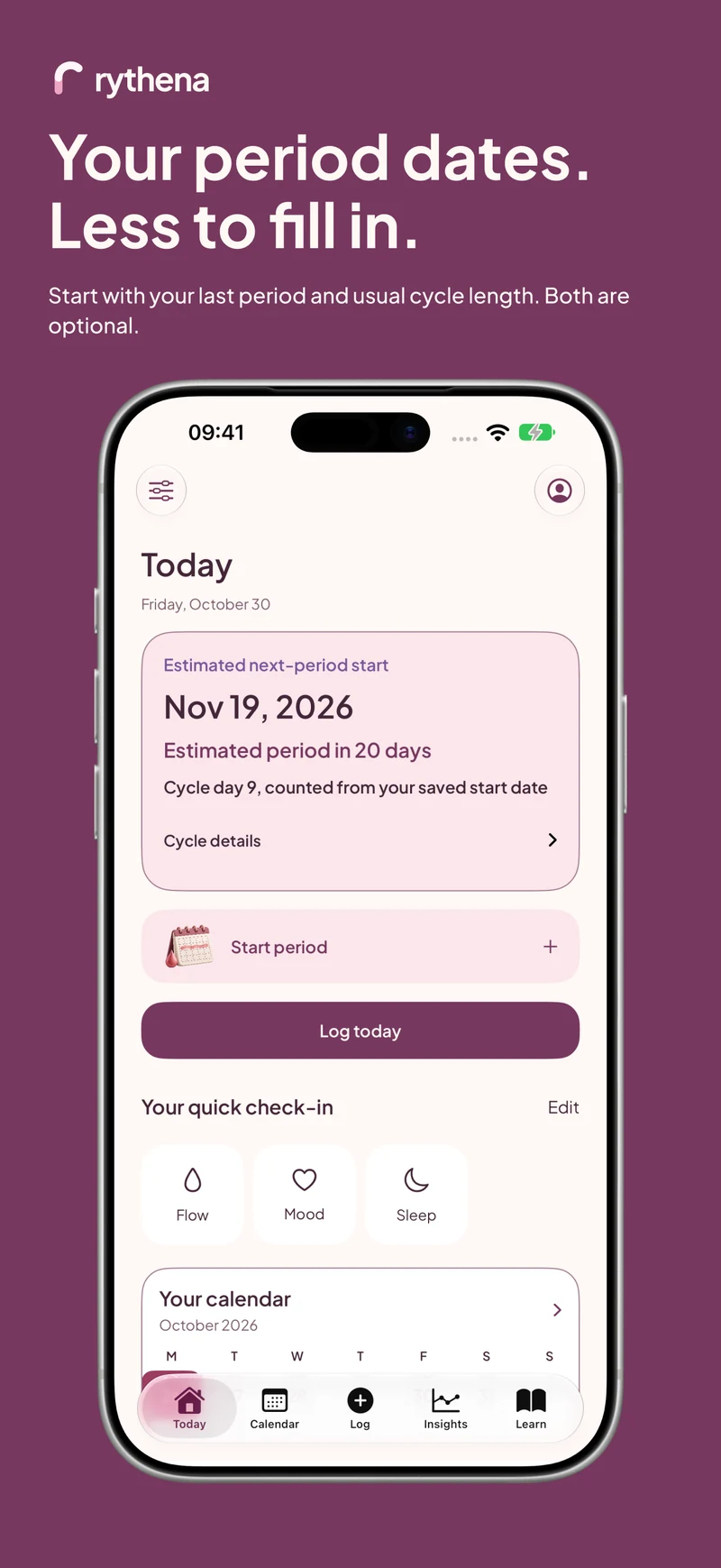
The upcoming Rythena app can use eligible setup/manual information to show an early estimate while keeping the journal useful if you prefer to leave unknown answers blank.
Why a new journal starts with less certainty
A fresh app does not know your recent period starts unless you provide them. It cannot derive a personal average from the fact that you have chosen a mood or completed onboarding.
If you enter a last start and usual cycle length, the app has a calendar assumption to work with. That information should remain visibly different from a forecast based on several completed start-to-start intervals. A detailed-looking graphic does not add evidence to the underlying data.
What counts toward a history average
Rythena's history mode needs at least three eligible intervals. Four valid successive starts can define three intervals; one completed bleeding episode does not provide three cycles simply because it contains several days.
This is also different from learning usual bleeding duration. Duration uses explicitly ended episodes and has its own selection rules. The app should not confuse “six days of bleeding” with “six completed cycles.”
Use the manual option only when it reflects your choice
If you know your usual length and want to use it, open Cycle details and Edit cycle calculation. Choose manual mode, check the value and save. The estimate remains calendar-based and subject to context and safety limits.
If you chose history and do not have enough eligible intervals, the app should explain that state. It should not quietly turn on manual mode behind the scenes. You can explicitly change the mode or simply continue recording without a forecast.
Do not backfill a perfect-looking past
It can be tempting to enter several monthly starts to make the calendar look ready. Unless you actually know those dates, doing so creates a history that the app may later treat as evidence.
Instead, add an older date only when you can verify it well enough for the record you intend. Leave the gaps visible. A first week of accurate information is a better foundation than a reconstructed year of guesses.
Know what an early fertility estimate means
The fertility layer is optional and has additional eligibility rules. If an early provisional layer appears, it is still an estimate. It does not confirm ovulation, and provisional visual estimates do not automatically qualify for fertility reminders.
If it does not appear, read the explanation. Do not change a tracking context or enter invented observations just to unlock a marker. The fertility-estimate guide explains the distinction, while the simple tracking guide shows what you can do immediately without more setup.
Sources & product basis
Product steps checked against Rythena’s upcoming iOS implementation and listing. Examples are illustrative. AI-assisted writing; no clinical sign-off. Sources checked 2 November 2026. Editorial approach and corrections.
Make it a smaller routine.
See the app, check what stays free and choose the tools that help you.