The short answer
Choose manual mode when you want your explicitly entered usual length to drive the estimate. Choose history when enough eligible recorded intervals are available. Neither choice removes variability or guarantees a date.
The choice between manual cycle length vs history average is really a choice about which information you want the app to use. It should be visible, editable and separate from the question of whether a prediction is safe to show.
Rythena's upcoming cycle settings preserve that distinction. Recording more information does not give the app permission to silently change a mode you selected.
Manual mode makes the assumption explicit
You might already know that a particular usual length is a useful starting point. Manual mode lets you enter it deliberately and see that it is the basis of the forecast.
For a synthetic example, a saved start on 1 August plus a manual 28-day length points to 29 August as a central estimated next start, if the profile is otherwise eligible. It does not establish that 28 is the person's biological length every month.
The strength of this mode is transparency. Its limitation is also transparent: an outdated usual value remains an outdated assumption until you edit it. The app cannot turn that number into new observations simply because it is convenient.
History mode uses eligible start-to-start intervals
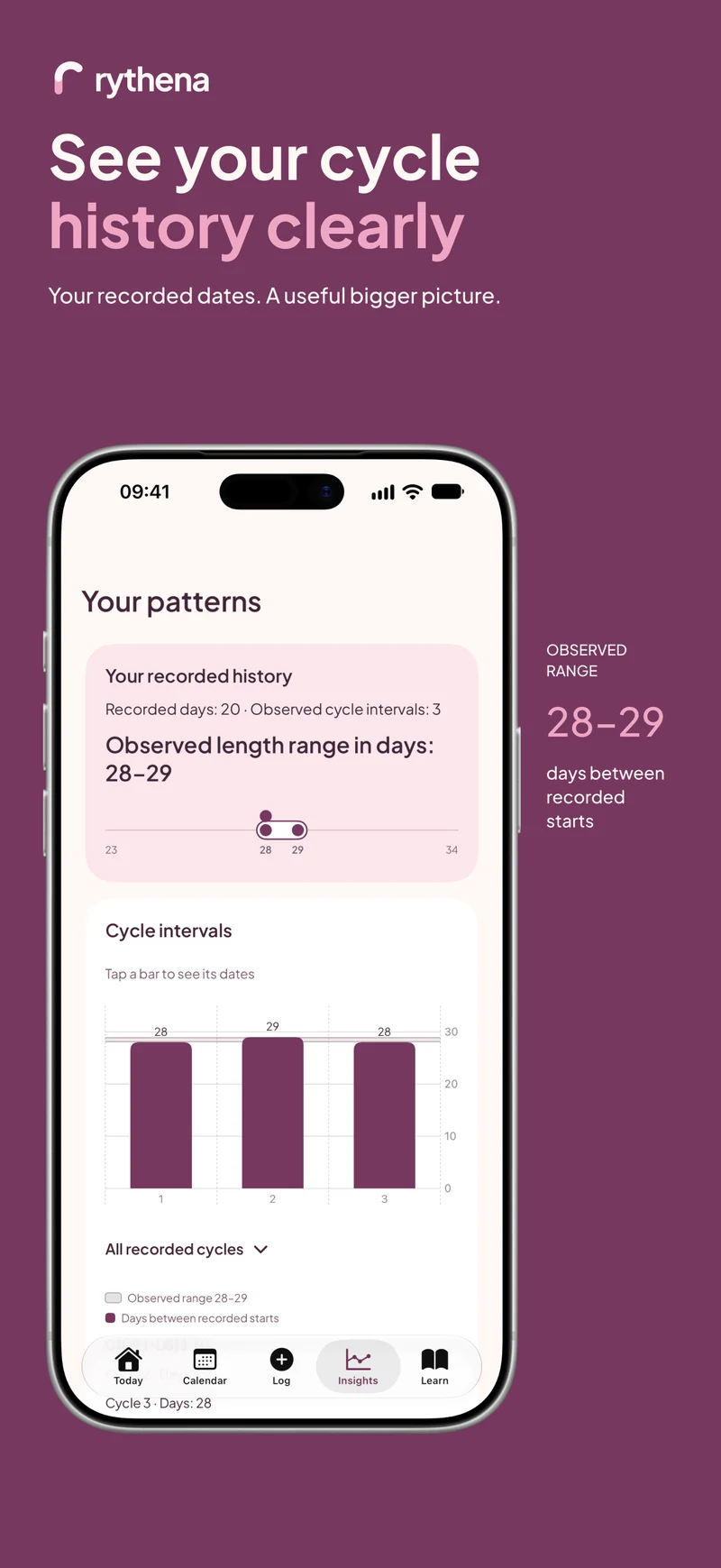
History mode needs at least three eligible recorded intervals, which generally means four eligible starts defining them. Rythena uses up to the six most recent eligible intervals and rounds the mean to a whole day.
The records still have to satisfy context and variability rules. A large number of saved entries does not necessarily provide a valid chain of period starts. Notes, symptoms and future or excluded records are not substitutes for those intervals.
A choice checklist
| Ask yourself | What to inspect |
|---|---|
| Do I know a usual length I want to use? | The manual value and the saved start |
| Do I have enough eligible history? | Recorded period starts, not total journal entries |
| Is the app withholding an estimate? | Its explanation and current tracking context |
| Did the result change unexpectedly? | Recent edits and the still-selected mode |
You can keep logging while deciding. A journal with an unavailable forecast is not an incomplete journal.
What not to change to get a preferred answer
Do not remove a truthful unusual start because it widens a range. Do not choose manual 28 merely because it moves a predicted period away from an event. Those edits alter the calculation's input, not what will happen.
Fix actual mistakes instead: a duplicate start, wrong date or setup answer you did not mean to confirm. Then inspect the result again. If a changing pattern concerns you, the record can support a healthcare conversation without the app explaining its cause.
Where to edit the mode
Open Cycle details, then Edit cycle calculation. Select the intended mode, check any manual value and save. Reopening the app should preserve that choice. The calculation detail should continue to say which basis is in use.
See how to calculate cycle length for arithmetic examples and why predictions can change for the difference between a new input and a new mode.
Sources & product basis
Product steps checked against Rythena’s upcoming iOS implementation and listing. Examples are illustrative. AI-assisted writing; no clinical sign-off. Sources checked 2 November 2026. Editorial approach and corrections.
Make it a smaller routine.
See the app, check what stays free and choose the tools that help you.