The short answer
Record the date, the discomfort you experienced and any practical impact you want to remember. Add intensity only if useful. A diary can support a care conversation but cannot diagnose or treat the cause.
A period cramp diary does not have to mean rating every sensation throughout the day. Sometimes the most useful observation is that discomfort interrupted an activity or felt different from your usual experience.
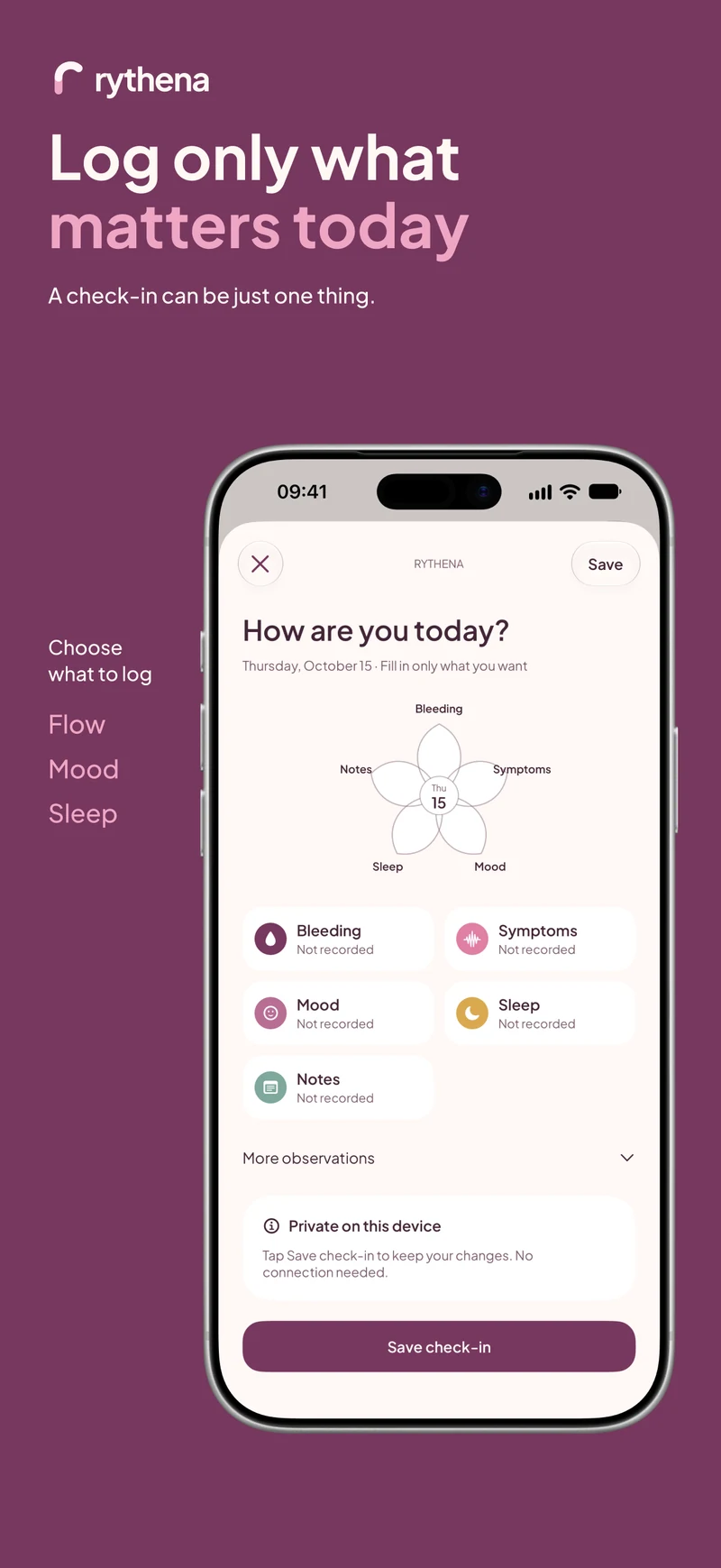
Rythena's upcoming symptom flow lets you select an observation before deciding whether to add detail. That makes it possible to keep a small record on a day when a long form is the last thing you want.
Choose a consistent description
Use the symptom label that best fits what you mean. If you want to add your own words, describe the experience rather than naming a cause you have not been assessed for.
An illustrative record might say “cramps, left work early.” Another might say “discomfort, stayed awake longer than usual.” Both capture impact without pretending that the app can explain why the pain occurred.
Check the date before adding detail
If you are logging later, verify the selected day first. A carefully written note on the wrong date can be difficult to interpret alongside a period start or other observations.
Select the symptom, add useful optional detail, return to the check-in and save. If you accidentally selected something else, remove it rather than relying on a note to explain that it did not happen.
Make intensity meaningful to you
An intensity scale is useful only when you understand what it represents in your own record. A number does not need to match another person's number to describe a change for you.
If a number is difficult to choose, plain language about impact may be clearer. “Needed to pause the walk” can be easier to remember consistently than deciding whether the day was a six or a seven. You can leave optional fields empty.
Use repetition as a question
After more recorded days, you may notice observations near similar cycle positions. That can be worth discussing, but it does not establish a diagnosis or prove that one factor caused the pain.
Check how complete the record is before comparing cycles. A month with only difficult days logged should not be interpreted as though every unlogged day was pain-free.
Do not wait for a complete diary to ask for help
The NHS advises seeking urgent help for severe or worse-than-usual pelvic or period pain when painkillers have not helped. It also recommends discussing pain that interferes with usual activities or periods that become more painful, heavier or irregular.
These are care decisions, not app milestones. A diary can help you explain dates and impact; you do not need to collect a certain number of entries before seeking appropriate support.
When useful, create the free standard PDF and review it before sharing. The symptom diary article explains how to make the important parts easy to find, and the symptom-tracker guide covers the optional logging controls.
Sources & product basis
Product steps checked against Rythena’s upcoming iOS implementation and listing. Examples are illustrative. AI-assisted writing; no clinical sign-off. Sources checked 2 November 2026. Editorial approach and corrections.
Make it a smaller routine.
See the app, check what stays free and choose the tools that help you.