The short answer
Use the journal to preserve real starts, ends and observations. Variation is information to keep, not an error to erase so an average or fertile-window estimate can appear.
Tracking irregular cycles can be frustrating if every screen seems to expect the same interval. A real record may include shorter gaps, longer gaps and older dates you cannot remember. The point of the journal is to preserve that reality.
The upcoming Rythena app can keep logging and history available when its forecasting rules withhold estimates. An empty prediction is not a judgment about your body.
Keep dates before interpreting patterns
Record the starts you know and the actual end of a tracked period when it is known. If you discover a mistake later, correct it. Leave an uncertain older date uncertain rather than using a convenient day from memory.
Write a short question if it helps you explain what changed. You might be interested in the interval between starts, the duration of bleeding or a symptom's impact. Those questions require different records and should not all be reduced to one average.
Averages can hide differences
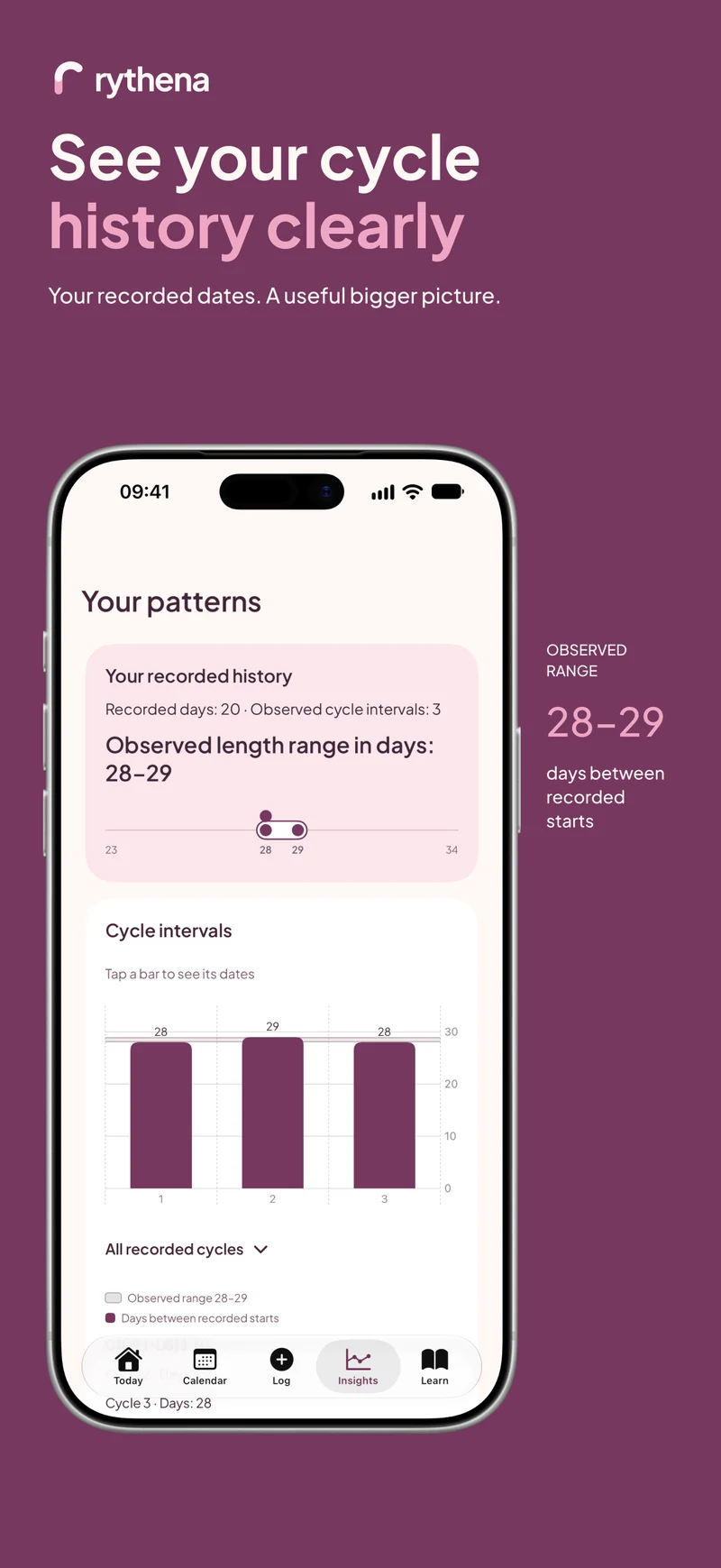
Two synthetic intervals of 22 and 34 days average 28. Two intervals of 28 days also average 28. The same mean describes two different histories.
That is why looking at the underlying intervals matters. A precise-looking central date does not show how much the intervals varied. Rythena's context and variability checks can prevent a forecast rather than present an average without a useful explanation.
Manual mode is not a safety override
Choosing an entered usual length tells the app which assumption you prefer. It does not require the app to show every kind of estimate in every context. Additional rules still matter, especially for fertility information.
If the app withholds a forecast, read the reason before changing settings. Do not enter a natural-cycle context or remove a real record only to obtain a marker. A more attractive result is not necessarily a more informative result.
Decide what is worth logging next
When dates already feel uncertain, a demanding daily questionnaire can add another burden. Start with period boundaries and one optional observation relevant to your question. A missing check-in should not be interpreted as a symptom-free day or an ended period.
If logging is adding pressure, simplify the routine. You can return to detailed categories later. The journal should remain useful without requiring a complete account of every day.
Use the record for a conversation
The NHS advises discussing irregular periods or a changed usual pattern with a GP. A record may help describe the change, but it does not establish its cause. Do not wait for the app to label a condition before seeking advice.
Review the relevant history and create a free standard PDF if you want a document to discuss. Add your main question separately. Keep estimated dates clearly distinct from recorded starts and ends.
The irregular-period guide explains the app workflow. See cycle length versus period length and the PDF report guide for two common sources of confusion.
Sources & product basis
Product steps checked against Rythena’s upcoming iOS implementation and listing. Examples are illustrative. AI-assisted writing; no clinical sign-off. Sources checked 2 November 2026. Editorial approach and corrections.
Make it a smaller routine.
See the app, check what stays free and choose the tools that help you.