The short answer
Use the estimated date and its uncertainty range to prepare supplies and flexible plans. Do not treat one predicted start or a fertile-window marker as a guarantee about what will happen on a trip.
A period tracker for travel can help you prepare, but the most useful forecast is not necessarily the most confident-looking one. A single date can suggest when to pack supplies; it cannot promise that your period will respect an itinerary.
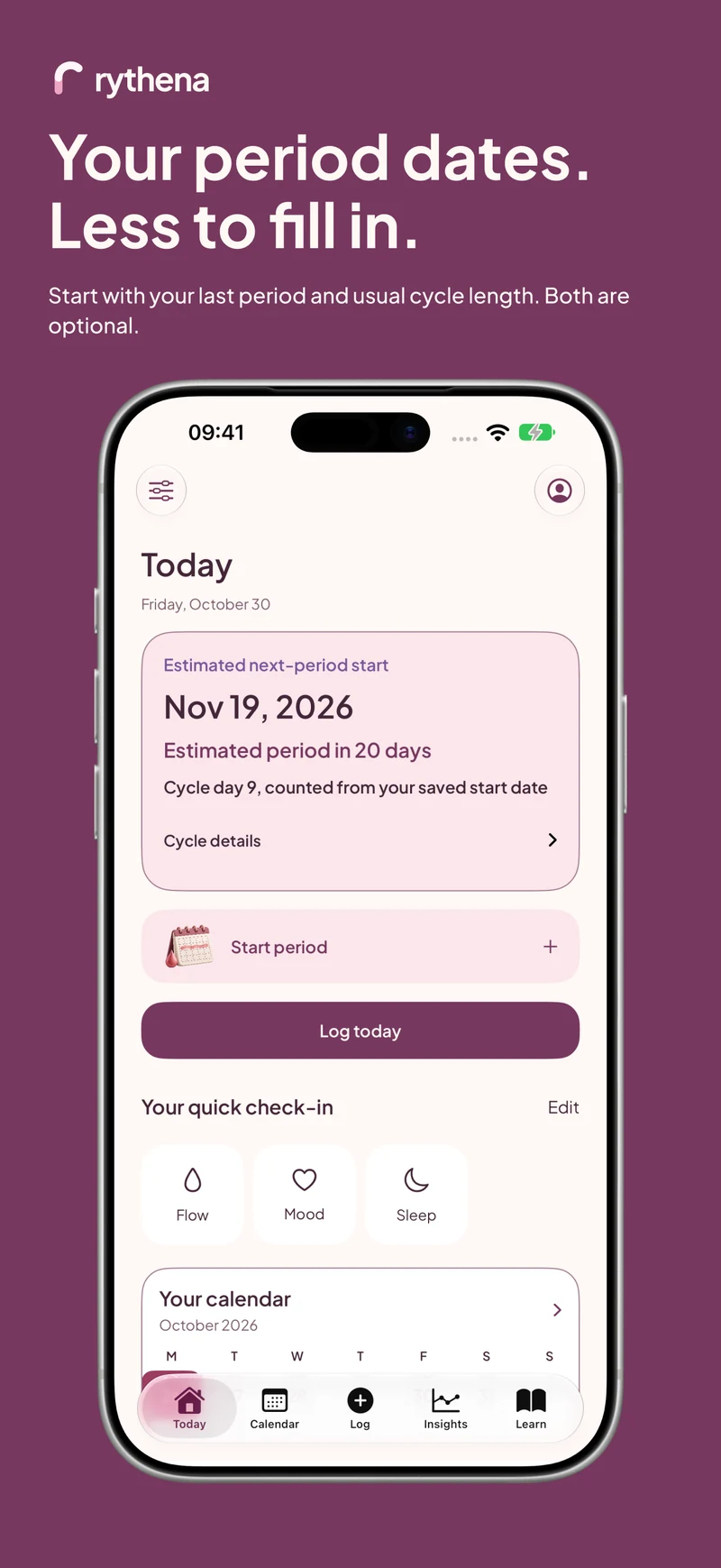
The practical goal is a little less uncertainty about preparation, not an exact calendar you must organize your life around. Rythena's upcoming Today and Calendar screens keep the word Estimated visible for that reason.
Check the date before the countdown
“In 12 days” is convenient, but you probably booked your trip by dates. Look at the estimated next-period start and compare it with departure and return. Then inspect the possible-start range rather than considering only the central date.
If the range overlaps your trip, plan for that possibility. If it does not, keep some flexibility anyway. A forecast outside the trip is not proof that you will not bleed while away.
Think in preparation decisions
Ask what action the estimate actually changes. It might remind you to pack familiar supplies in accessible luggage, review an existing plan for your own comfort or leave space in a tightly scheduled day.
You do not need to infer a future mood or energy level from a phase label. A plan can remain flexible without assuming your personality or abilities will follow a calendar. Your own preferences matter more than a general phase story.
Know whether the estimate is manual or history-based
Before a trip, open Cycle details. If the estimate is based on a manually entered usual length, check whether that is still the number you intend to use. If you selected history, inspect whether enough eligible records are available.
Do not switch modes merely to move the estimated date away from your holiday. A different setting changes the calculation, not the underlying biology. If you correct a genuine recording error, check the recalculated date afterward.
Do less logging while you are away
A travel routine might be checking Today and recording only a period start or end. You can keep optional mood and symptom categories for days when you want them, without committing to a detailed diary for the whole trip.
If you later add a remembered observation, check the selected date carefully. Do not fill unknown days with assumptions. A short, honest record is easier to interpret than a complete-looking diary rebuilt from guesses.
Keep the phone itself in mind
Decide whether cycle details belong on a Lock Screen widget or visible notification preview while travelling. Core local tracking and optional online features have different connectivity needs. A widget may update later than the app because iOS schedules its refresh.
For the current saved state, reopen Today. The countdown guide, private tracker guide and widget privacy article explain these choices without asking you to complete a larger routine.
Sources & product basis
Product steps checked against Rythena’s upcoming iOS implementation and listing. Examples are illustrative. AI-assisted writing; no clinical sign-off. Sources checked 2 November 2026. Editorial approach and corrections.
Make it a smaller routine.
See the app, check what stays free and choose the tools that help you.